Problem: How might we use circular economy principles to rethink the storage, delivery, and dispensing of tablet medication?
Solution: A policy brief proposal that encourages relevant parties to employ circular economy principles so they can tablet medication waste while adhering to safety guidelines.
Project Deliverable
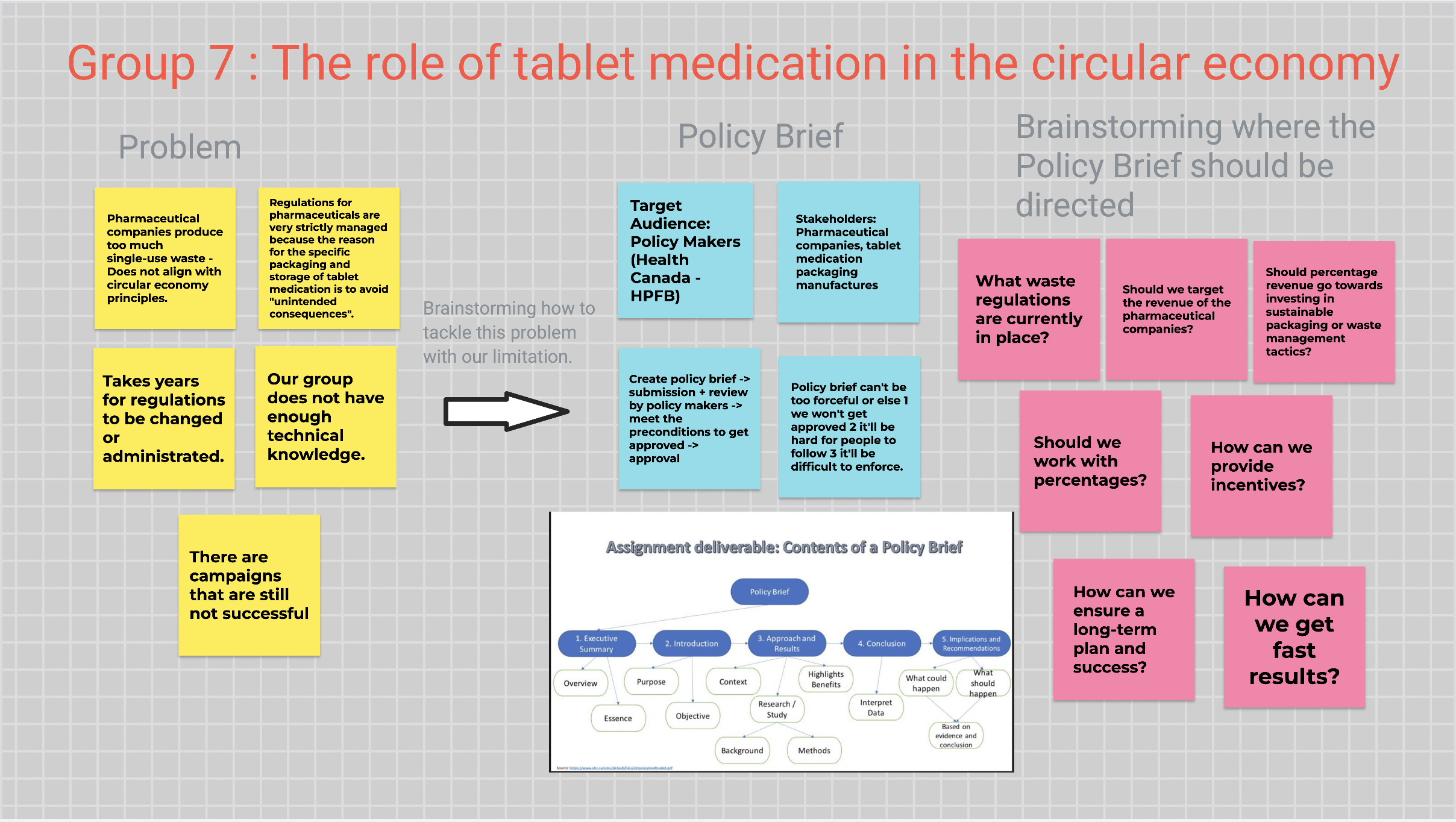
Target Audience: Health Canada HPFB (Health Products and Food Branch). Project Deliverable is designed to demonstrate the problem and our solution to a larger audience.
Design Criteria:
- Any storage method must adhere to the strict drug-safety guidelines.
- We want to have notable impact on people who can make decisions. We intend to specifically encourage circular economy principles, instead of, for example, monetary punishments.
- Even though consumers are not a part of our target audience, they are a stakeholder. We want to give them incentive to support more sustainable drug products.
- A balance between human desirability, economic viability, and technological feasibility
I think we met our criteria fairly well. Scroll down to read article "Synthesizing information to avoid the Swedish Bad Lion: Applying Critical Thinking Skills."
Cool things I learned
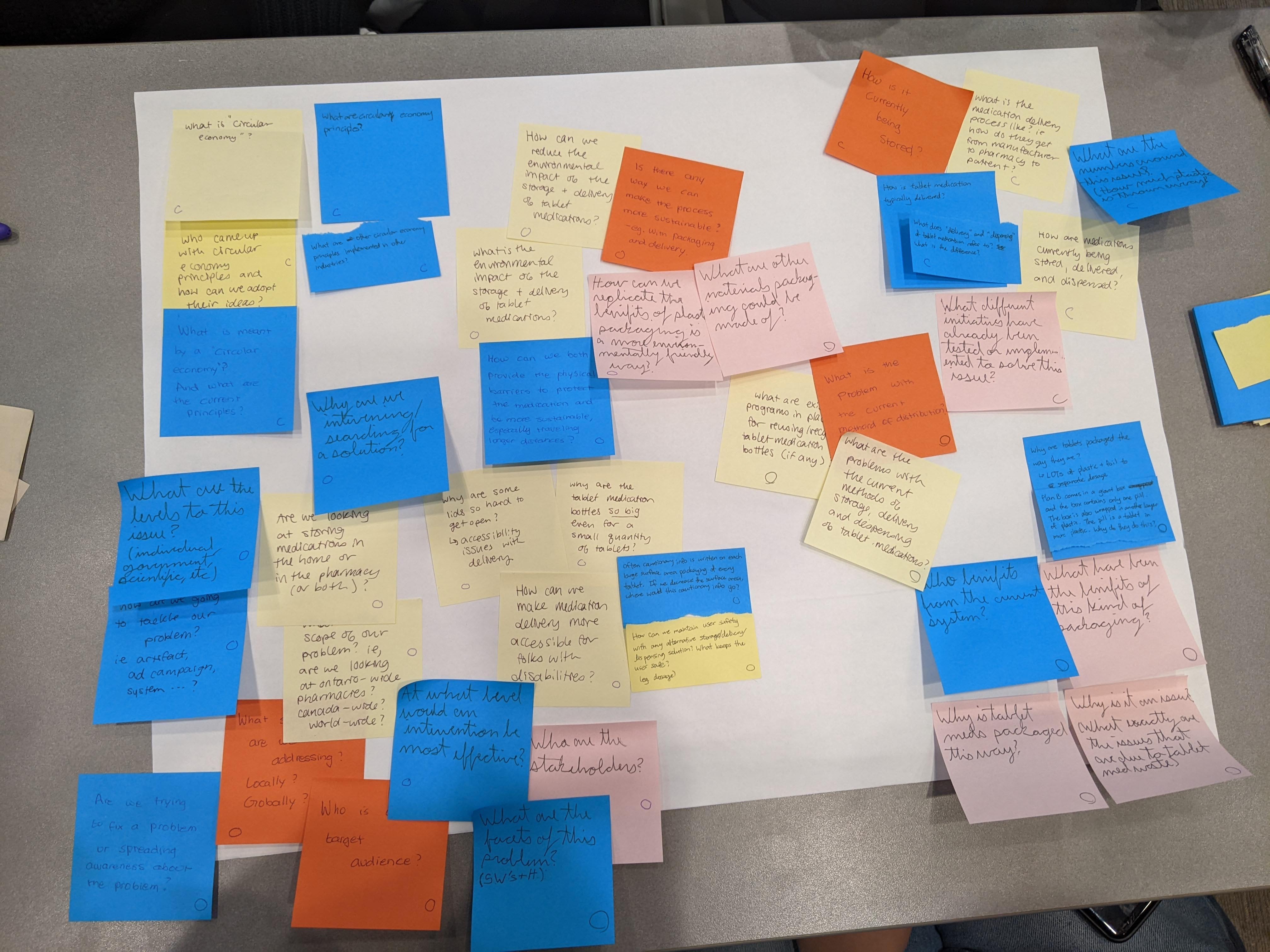 Question Formulation Technique!
It really helped me identify gaps in knowledge and be able to think critically about my assumptions and "unkown unknowns."
 Theory of Change!
This way of thinking was particularly impactful for our problem. We were asked to "rethink" tablet medication, but it was very difficult to determine what we wanted to rethink. Theory of Change synthesizes the atomic aspects of the desired result and their corresponding solution paths, hence presenting the problem in a "big picture" and gives clear pointers to our next steps. I see myself using this technique in future projects when I am stuck.
Relevant SDG's
- [12] Sustainable consumption and production
 The Swedish Bad Lion is a result of making models without researching biology. We were tasked to work with tablet medications, but none of us are experts in the field.
As part of a design-thinking project in a project-based course, I worked in a group of four to design a solution that employs circular economy principles to reduce tablet medication waste. The problem could become highly technical, but none of us had any expertise in medications. My critical thinking (metacognition) skills played a significant role in reaching a balance between economic viability and technological feasibility (and human desire). (Change by Design, Tim Brown) In particular, the process required extensive research due to our limited background in the field. For the sake of efficiency, our group members divided the research questions. I had to synthesize and think about our questions, thoughts, and findings in a very metacognitive way because I am not an expert in tablet medications, and "common sense" might not come as naturally to me. This was quite challenging: I have never attempted a problem in such a foreign field. My work led to a big turning point in our project: we had to remove more than half of all ideas/prototypes we could come up with because they are not economically viable or technologically feasible.
My trek to balancing Tim Brown's design constraints
At the beginning of the project, my group had the tendency to work with a technical solution, such as remodeling tablet medication packages. However, during my periodic reflections on our progress, I realized that we can not only do a non-technical solution (that is, we forgot about this whole solution space), but we might not even have the proper technical background to conduct a technical solution. I volunteered to research tablet medication regulations to check on our group's inherent assumptions. It turns out that a technical solution is nearly impossible due to our limited technical background.
Design thinking discourages the act of "turning down ideas." Once I learned more about the technical regulations of tablet medications, I proceeded to violate this rule. Because the initial norms were to not violate design thinking rules (we are in a design thinking course), I convinced my group members with my reasonings:
- Some ideas are absolutely laughable to an industry expert (for example, "let's add some extra coating to the tablet to replace the package" doesn't work because coating material and thickness are determined by where scientists want the tablet contents to dissolve in the digestive tract). In a technical project group, these ideas will not even be brought to the table because everyone knows that they won't work. We do not have the background and intuitions of an industry expert, hence it is hard for us to figure out what is a "dumb idea" or realize the technical skills required to execute the idea. Some of our ideas might violate regulations or are technically infeasible in our hands, hence they should be removed.
- A part of the scientific community culture mocks policymakers for "not knowing what they're doing." More precisely, this mocks policymakers for making statements that don't follow the science. Technologically inconsistent solutions violate our design criteria.
I began to periodically evaluate research results: why can some parties execute their solutions (like a new packaging material) and is that something doable by our skills? I synthesize my evaluations and connect them to our group's progress. This gives the whole group better benchmarks for what makes a solution economically viable and technologically feasible. I also learned to periodically check our prototypes with our targets, stakeholders, and impact value because these are all important aspects of our design criteria.
Towards the end of our project, we finalized our solution to a policy brief proposal. My metacognitive skills were once again vital in catching loopholes and matching our solution to our design criteria. For example, I pointed out that from my previous studies in economics, taxation negatively impacts boths suppliers and consumers, making the solution less desirable and human-centered.
Impact
I not only managed to filter out the majority of solutions that are not viable nor feasible, but I also spearheaded our group's change from searching in the technical solution space to the non-scientific solution space.
I consider my efforts successful:
- We did not become policymakers who making incorrect assumptions to science.
- Our solution hits a decent balance between human desirability, economic viability, and technological feasibility. (Change by Design, Tim Brown) In our final presentations, we received consistently positive feedback on our performance regarding these design principles.
In the process, I realized the importance of systematic approaches to problems because they force us to consider aspects that may not naturally pop up in our minds. I learned that there is more to design beyond design thinking: sometimes the values presented by design thinking are conflicting, and it is up to the problem solvers to determine which values matter more than the other. These core critical thinking skills helped me expand the scope of projects I can attempt by giving me guidance on how to approach projects in field I'm not familiar with.