Objective: We aim to create a PSA so that UWaterloo food service consumers can be informed of and take action for more sustainable food choices.
Client: UWaterloo Sustainability. Our design supplements UWwaterloo Sustainability's create awareness and inspire UW staff and students to make sustainable food choices.
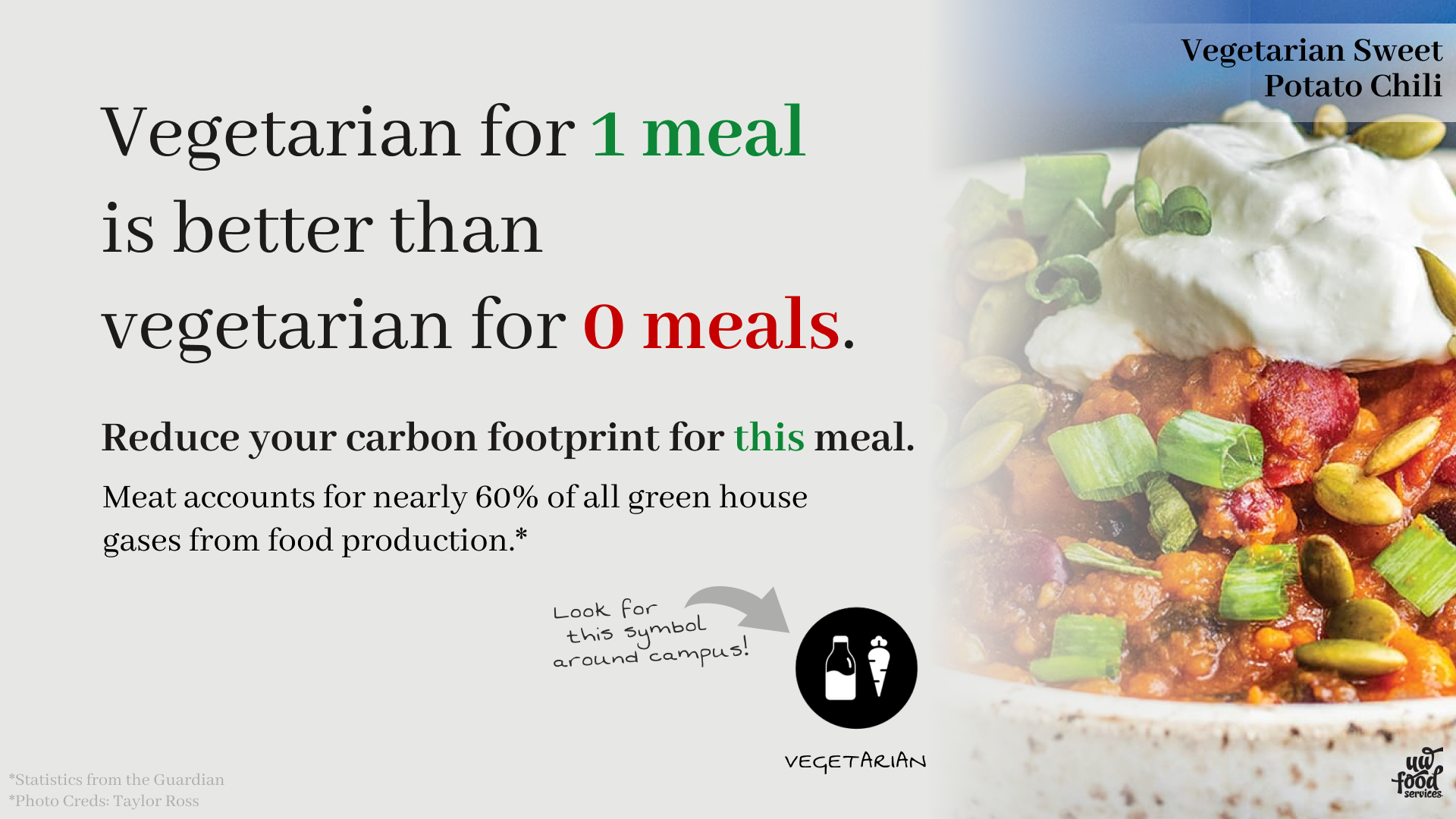 Our PSA
A tasty, colorful picture grabs attention. Green-red and 0-1 dichotomies inspire interest. To non-vegetarian readers, "for 1 meal" sounds easier than full vegeterianism. This and the tasty image evoke desire. Environmental incentives and statistics prepare the reader to take action. (AIDA Framework: Attention, Interest, Desire, Action)
Our Prototypes
Design Criteria:
- Meet display specifications.
- Target UWaterloo students and staff.
- Human-centered digital design (eg plain white is harsh on the eyes).
- A huge fraction of UWaterloo students/staff are not aware of sustainable food options, so we will target this demographic.
- AIDA Framework
Cool things I learned
Conflict Management
I exercised lots of conflict management in this project.
- I found it helpful to care for each other's feelings by giving "vaccines" to potential conflicts.
- I collated everyone's opinions onto one platform and accounted for all types of speakers by giving everyone their own chance to confirm the group's synthesis of their opinion is accurate. Many conflicts can be resolved once we express ourselves clear enough.
- We also had a design criteria. When we struggle to make decisions, the design criteria can often make decisions for us.
- And when we can't, having an accurate picture of the floating thoughts allows everyone to construct accurate reasonings and arguments, hence resolving the conflict at a happier level. The final common ground might be better than all of the possbilities debated over.
Scroll down to read article "My favorite conflict resolution experience," where I dicuss my experience helping our group decide between two prototypes but ending on a resolution that was better than both prototypes.
Routine Ideation -> Prototyping -> Evaluation -> Iteration
Routines allow us to approach the problem more systematically. They lessen explanations and improvised adjustments to unexpected changes. Over our large amounts of ideation and many iterations, we documented our solution's growth very well.
Our ideation
A wellformed cycle of Ideation -> Prototyping -> Evaluation decreased the unpredictability in our project. As my first design thinking project, the routine cycle was especially helpful for adjustment. We had asynchronous feedback/commentary elements to our cycle we I found helpful for working together remotely.
Relevant SDG's
- [3] Good health and well-being
- [11] Sustainable cities and communities
- [12] Responsible consumption and production
- [13] Climate action
What was going on
As part of a design-thinking project in a project-based course, I worked in a group of three to craft a PSA to support sustainable food practices. Design thinking involves extensive interpersonal interactions in order to build on each others' ideas and prototypes. This allowed me many opportunities to use my conflict management skills to improve our process in refining and improving PSA protoypes. Our whole group is new to the idea of design-thinking and the diversity of design opinions it could involve; one of our course readings describe the process as "chaotic" to newcomers. So, a major challenge of this project is coming to a common ground on our design thoughts. I helped our group settle disputes much more efficiently and in turn helped us refine our prototypes more efficiently.
Why we had conflicts in the first place
In the beginning phase of our brainstorming, I contemplated the effects of our design-thinking-based brainstorming/iteration methods on our group. My project experiences in software development and related industries proved that frequent, small cycles of prototype and integration (known as agile development) is much more efficient and scalable than "divide and conquer." My studies on design thinking also support such iterations of prototyping and improvements by tackling the problem one step at a time. For its benefits, we have a high frequency of idea integration sessions where we ask clarifying questions to each other and provide constructive comments. However, any process comes with its drawbacks. I foresaw a high frequency of disagreements.
What I did
As soon as I realized these potential issues, I raised my thoughts to my teammates to prepare us for any disagreements. Instead of abandoning the design-thinking appraoch, I ensured everyone was prepared for possible conflicts so we don't damage each others' feelings.
During one of our biggest conflicts, each group member had directly conflicting opinions on how might we improve a set of prototypes. Initially, we spent minutes bouncing counterarguments back and forth. I realized that this was inefficient, so I decided to record each persons arguments and counterarguments into a collated document by annotating the design board. This helps us visually determine where the largest conflicts lie and construct a better image of which conflicts are about what. (Auditory signals are difficult to remember.) I asked each group member to make sure all of their opinions were all representative and included on the document before we proceeded to analyze our own opinions.
I then drove us to consider our annotations in the context of the design problem and criteria. This was very significant because it turned out that many of our arguments did not have a direct connection to our design brief. Referring to our design brief during conflicts helped us refocus our problem. For example, I noted that our designs were meant to be looked at from a distance, so we should match the real life situation by evaluating our designs on a large screen from a distance. I suggested each member to take our own time to re-evaluate our prototypes from the context of our design brief. This allowed us more time to think through the prototypes as our previous opinions didn't consider the actualy problem much. In doing so, I not only prevented us from falling in love with our solution instead of the problem, but also ensured that everyone had the opportunity to restructure our opinions when the context changes.
Finally
After some hours of individual thought, our group collaborated together with our new feedback to construct new prototypes that were much better than any of the prototypes we were debating on. This prototype ended up being the baseline for our final PSA design! I'm happy that I used conflict management strategies to not only bring everyone to a common ground, but also one that every member prefers over the previous prototypes. Finally, I believe that we had two key aspects that contributed to the success of this conflict management:
- I ensured honesty, inclusivity, and communication
- Referring to our design brief during conflicts helped us refocus our problem.
I will continue to drive these two practices in future project conflicts.